
Concrete guide
Sidewalk Injury Statistics and What the Data Actually Measures
Original U.S. research on sidewalk falls, uneven concrete, and walking injuries, with clear dates, denominators, and Wisconsin winter context.
Published October 3, 2026 · 6 min read

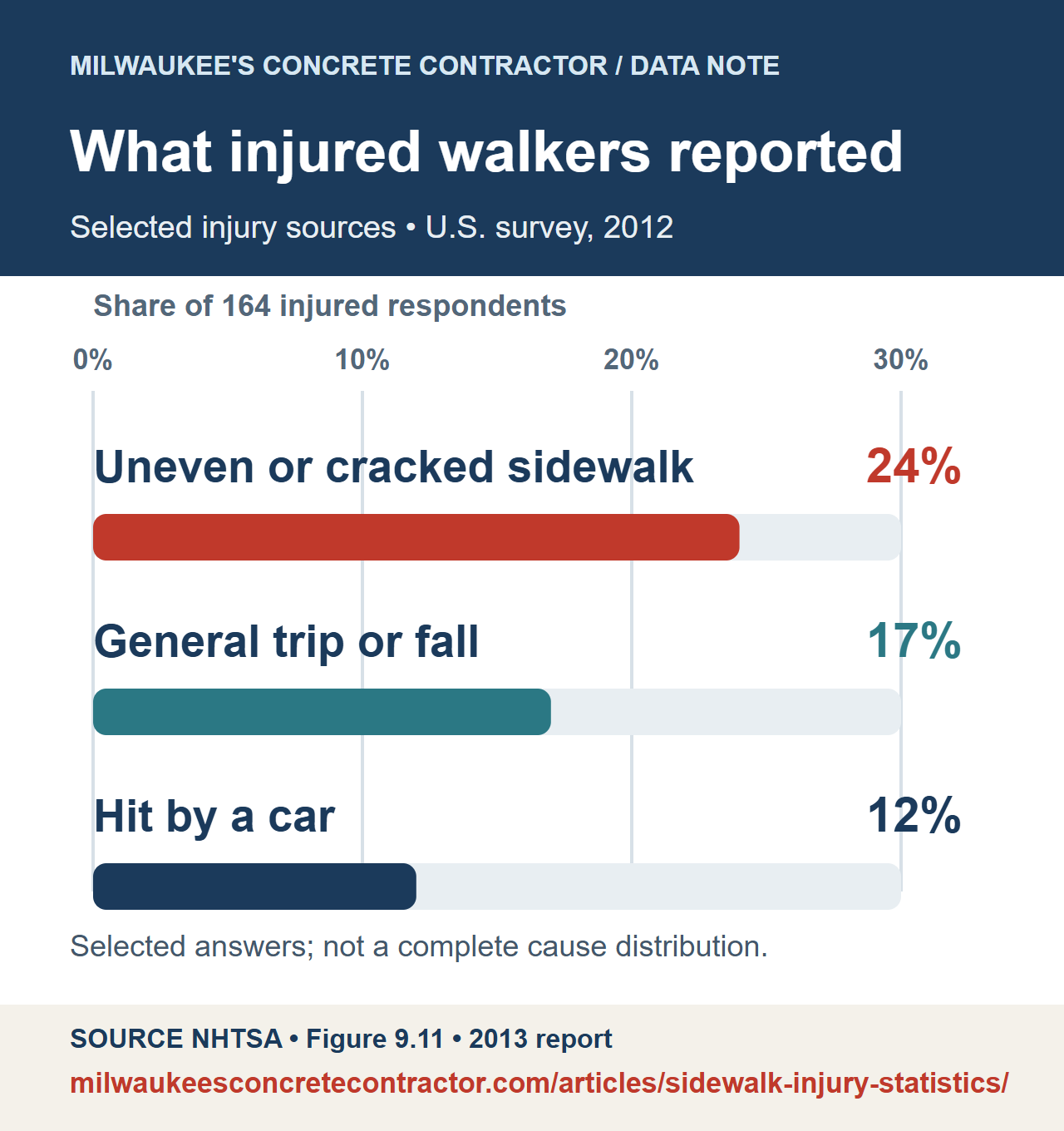
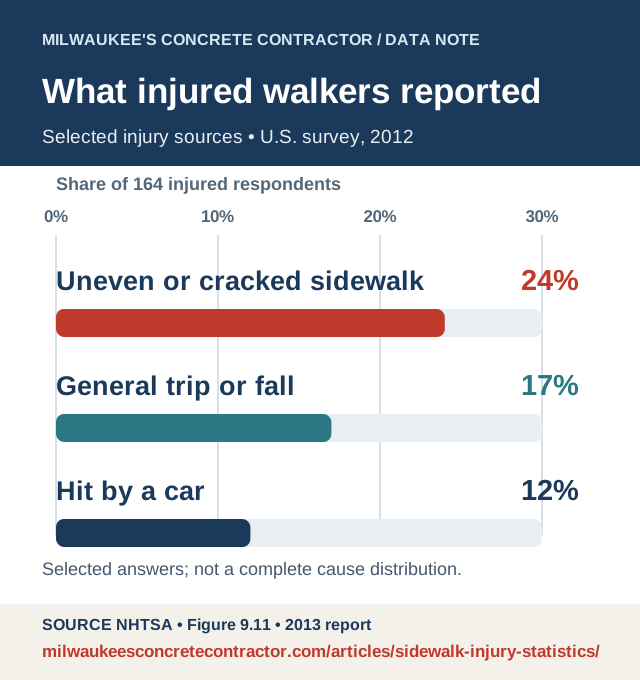
In a national survey conducted in 2012, 24% of people who reported a medically attended walking injury identified tripping on an uneven or cracked sidewalk as the injury source. That is the most direct sidewalk condition statistic we found, but it comes from a small group of 164 injured respondents. It is not a current estimate of how many Milwaukee residents are hurt on sidewalks. Source: National Highway Traffic Safety Administration, Figure 9.11.
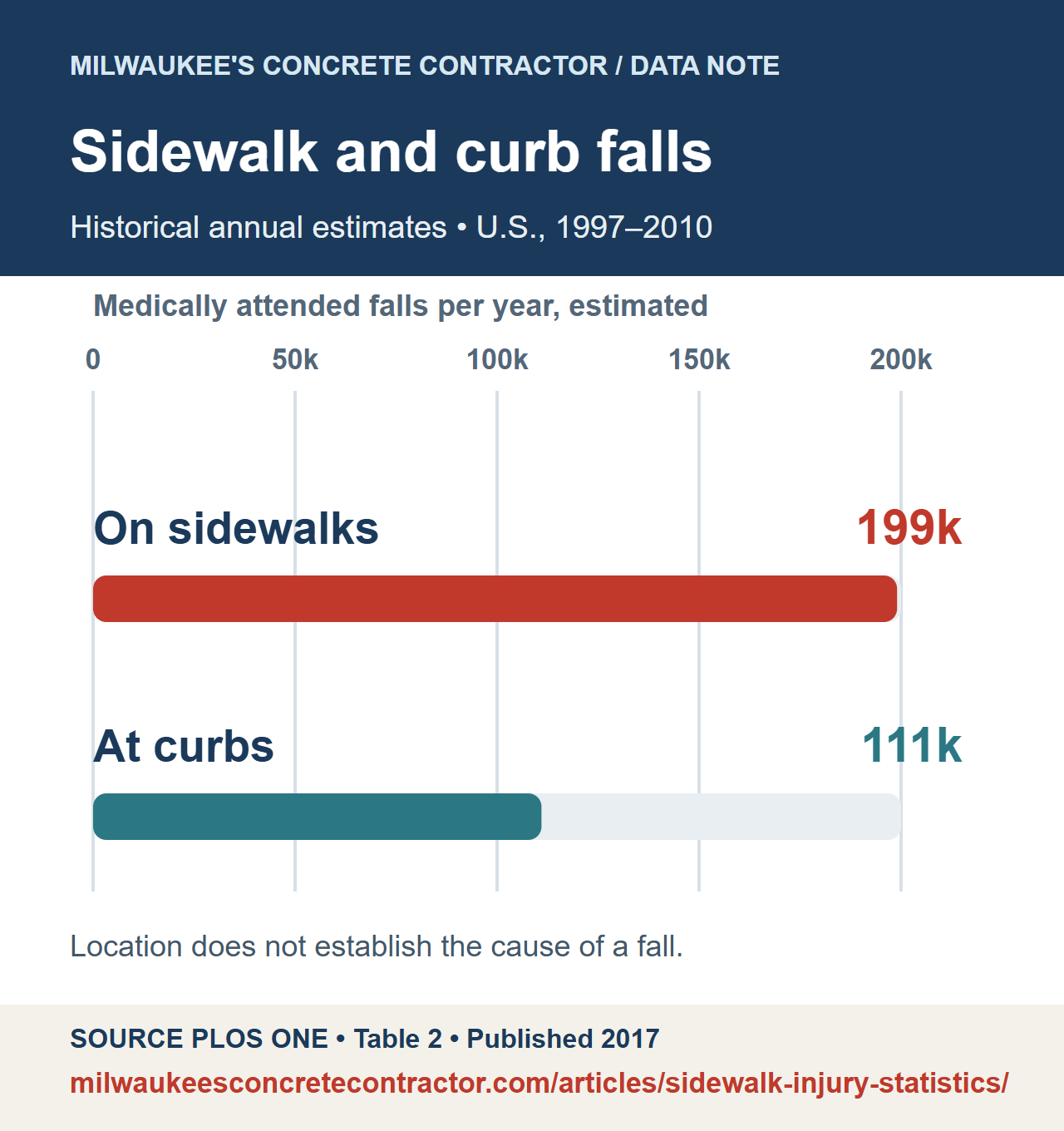
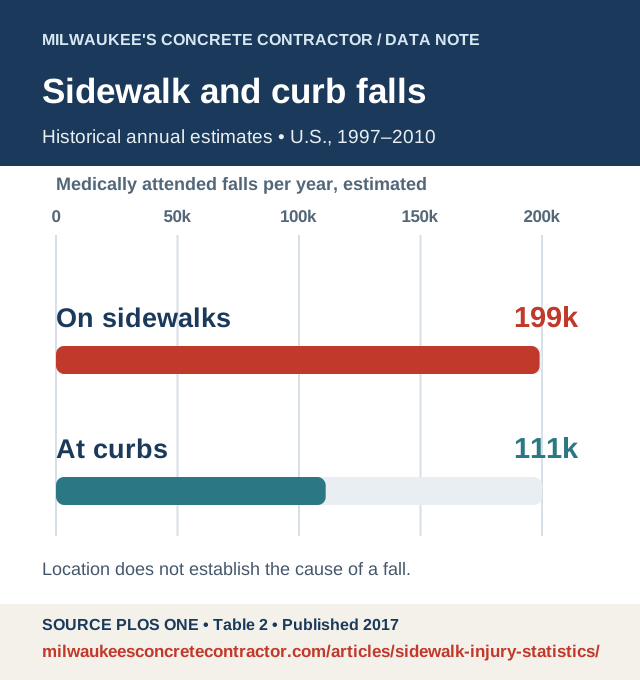
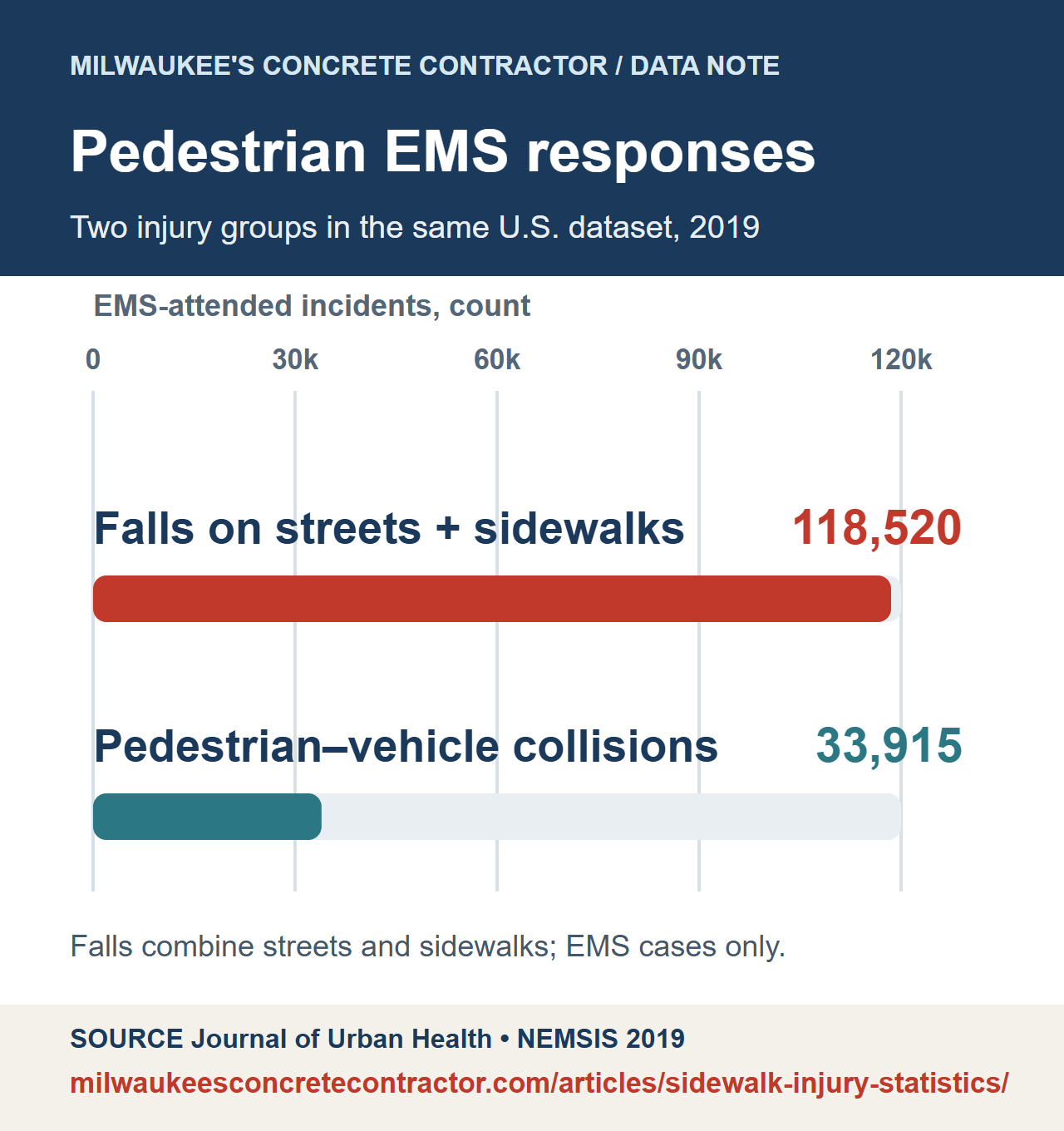
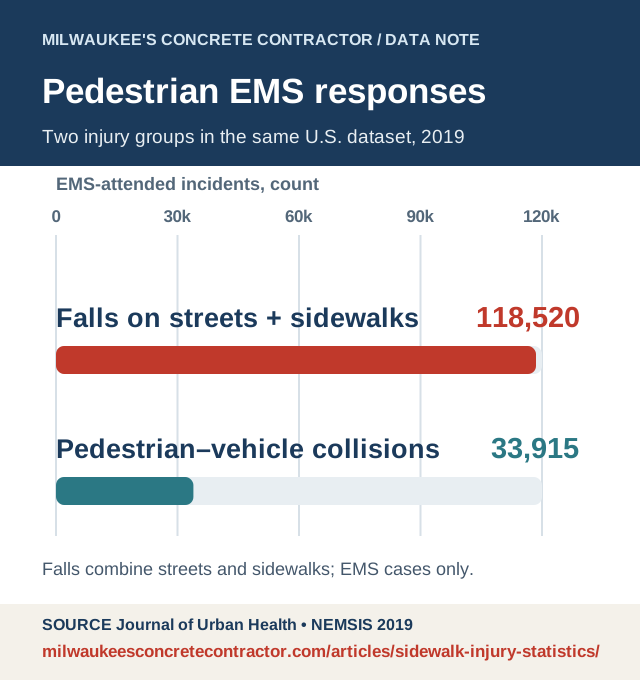
The larger picture is also important. A separate analysis of U.S. health interviews from 1997–2010 estimated 199,000 medically attended fall injuries on sidewalks per year during that study period. A 2019 emergency medical services study counted 118,520 injurious pedestrian falls on streets and sidewalks combined. These are different populations and methods, so the numbers cannot be added or treated as a trend. Sources: PLOS ONE, Table 2; Journal of Urban Health, abstract.
Four numbers worth understanding
| Finding | What it measures | Period and important limit |
|---|---|---|
| 24% cited an uneven or cracked sidewalk | Share of 164 survey respondents reporting a medically attended walking injury who named this injury source | 2012 U.S. survey; small subgroup, self reported (NHTSA, Figure 9.11) |
| 199,000 per year on sidewalks | Estimated medically attended fall injuries located on sidewalks | U.S. interviews from 1997–2010; historic annual estimate (PLOS ONE, Table 2) |
| 90,000 per year linked to cracked or uneven pavement or sidewalk | Estimated medically attended falls with that surface hazard in the injury narrative | Same 1997–2010 U.S. study; category includes pavement beyond sidewalks and can overlap the location count (PLOS ONE, Table 5) |
| 118,520 street or sidewalk falls | Injurious pedestrian falls attended by EMS | 2019 U.S. EMS data; streets and sidewalks cannot be separated in this result (Journal of Urban Health, abstract) |
What the survey says about sidewalk condition
The NHTSA walking survey asked U.S. adults 16 and older about the previous two years. Among those who had walked in that period, 3% reported an injury while walking that required attention from a medical professional. Among the 164 injured respondents answering the source question, 24% selected an uneven or cracked sidewalk, 17% selected a general trip or fall, and 12% said a car hit them. These percentages describe the survey respondents and their answers, not the share of all U.S. injuries attributable to concrete defects.
The same survey asked about sidewalk use. Among people who had neighborhood sidewalks and had walked outdoors in the prior year, 34% said they used sidewalks every time and 41% said they used them most of the time. Among a much smaller group who hardly ever or never used available sidewalks, 12% named poor repair as the main reason. These are use and perception measures, not evidence that a specific repair reduces injuries. Source: NHTSA, Figures 9.7 and 9.8.
What the fall injury study adds
Researchers coded injury narratives from the National Health Interview Survey. Their historical annual estimates put 199,000 medically attended falls on sidewalks and 111,000 at curbs. Sidewalks represented 2.5% of all medically attended fall injuries in that study, while curbs represented 1.4%. The categories describe where a fall occurred. They do not say that a sidewalk or curb defect caused every fall. Source: PLOS ONE, Table 2.
The researchers also coded possible hazards separately. Cracked or uneven pavement or sidewalk appeared in an estimated 90,000 fall injuries annually in the study period. Ice or snow appeared in 6.2% of medically attended fall injuries across all locations. Because location and hazard are different fields, these values can overlap; adding them would double count some injuries. Source: PLOS ONE, Table 5.
Why the newer EMS count is broader
The 2019 EMS study identified 118,520 injurious pedestrian falls on streets and sidewalks combined, compared with 33,915 pedestrian–motor vehicle collisions in the same dataset. EMS classified 19% of fall patients and 32% of vehicle collision patients as emergent or critical. Even with a smaller severe share, the count of emergent or critical fall patients was 2.1 times the collision count. For patients 65 and older, the count ratio was 6.1. Those are counts of EMS patients; the figures do not show an individual’s chance of falling on any given walk.
Wisconsin winter context
Wisconsin’s Department of Health Services reviewed workers compensation claims involving ice or snow during October–April in 2000–2022. It found 33,597 qualifying slip, trip, or fall claims, and workers ages 45–64 were about four times as likely to file such a claim as workers ages 18–24. This supports paying attention to winter walking surfaces, but the dataset covers workers and many kinds of indoor and outdoor surfaces. It does not count sidewalk injuries in Milwaukee. Source: Wisconsin DHS winter work injury surveillance brief, page 3.
What a property owner can do with this evidence
These studies support a simple inspection habit, not a universal numerical threshold for repair. Walk the route in daylight and after rain or a freeze. Look for lifted panel edges, rocking slabs, cracked transitions, pooled water, poor drainage near steps, and spots that hold ice. Photograph the whole route and each problem area with a ruler for scale, then note whether the condition changes through the season.
The right fix depends on why the walk moved. An intact but settled panel may be a candidate for concrete leveling. A broken panel, recurring washout, or a route with poor grade may need a different repair or replacement. Our Milwaukee sidewalk and walkway service explains how we assess those choices. If a nearby slab is cracking too, the guide to reading concrete slab cracks covers what to record before requesting an assessment.
Research note
The figures above come from four original sources. The NHTSA survey is from 2012 and its injury-source subgroup is small. The PLOS ONE analysis uses 1997–2010 interviews and estimates an annual average for that historical period. The EMS study uses 2019 responses and combines streets with sidewalks. The Wisconsin study is workplace claim data, not a count of public sidewalk falls. None provides a current Milwaukee rate or a causal estimate of injuries prevented by repairing a particular walkway. The three original charts can be shared with a link to this article and their cited primary source; each downloadable image includes the article address.
Need a second opinion on the concrete?
Call 414-219-1661 or send the details through the quote form below.