
Concrete guide
How to Stop a Concrete Driveway from Sinking
Learn why a concrete driveway sinks, what you can check safely, and when lifting, repair, drainage work, or replacement is the better path.
Published July 21, 2026 · 4 min read
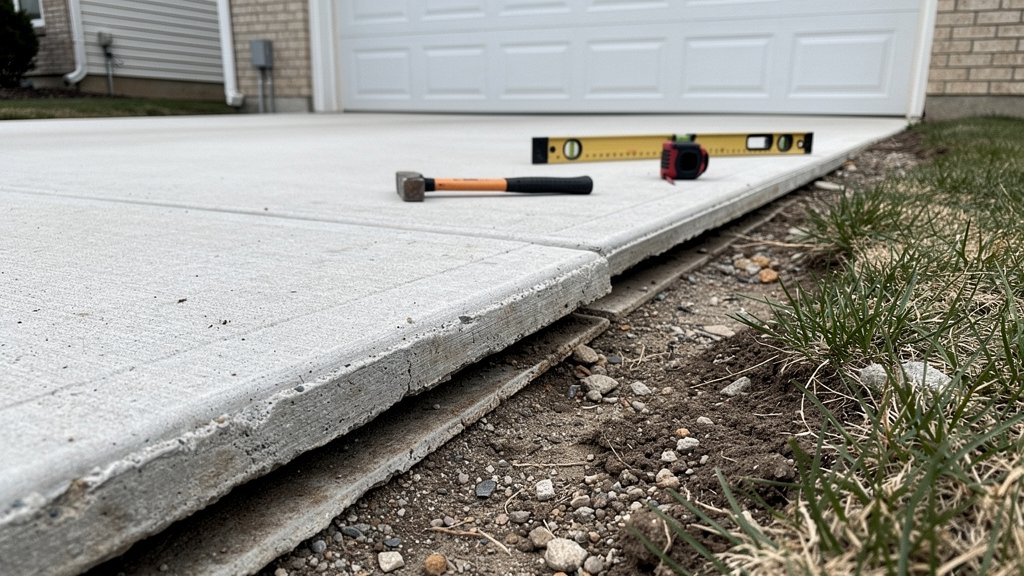
A sinking concrete driveway is usually a support or water-management problem before it is a surface problem. One panel may settle because the base was thin, soil washed out near an edge, a utility trench compacted unevenly, or water repeatedly reached the supporting layers. The right fix starts by finding the pattern rather than filling the low spot and hoping it stays put.
First, confirm what is sinking
Look across the full driveway, not just the lowest panel. Use a straight board or a long level to compare the panel to the adjacent concrete, garage threshold, sidewalk, and edge. Photograph the area when it is dry and after rain if possible. Note whether the panel rocks, whether a crack is widening, and whether water runs toward the home.
Do not crawl under a suspended or broken slab, dig beside a foundation, or try to lift concrete with improvised jacks. A driveway can be heavy enough to crush equipment or create a sudden pinch hazard.
Common causes of a sinking driveway
| What you notice | Likely mechanism | Clue that helps narrow it down |
|---|---|---|
| Low panel near a downspout | Water is softening or washing out the base | Soil stays damp or runoff discharges beside the slab |
| Settlement along a utility line | Trench backfill compacted differently | A long, narrow depression follows the route of the line |
| Several panels lower together | Broad base or subgrade movement | Cracks and slope changes continue across the driveway |
| Edge drops beside the lawn | Unsupported edge or erosion | Soil is missing below the outside corner |
| Garage transition is uneven | Settlement near the building or poor original grade | Water or snow collects at the threshold |
Repair options, from narrow to broad
1. Correct the water source
If a downspout, grading issue, leaking line, or edge washout is feeding the problem, address that first. A lifted panel can settle again if the same water continues moving below it. Keep changes on your property and respect local drainage requirements; redirecting water toward a neighbor or the public walk can create a new problem.
2. Lift a suitable panel
Professional slab lifting, including concrete mudjacking for a settled driveway, may be considered when the concrete is reasonably intact, the void is accessible, and the surrounding conditions can be stabilized. The goal is to restore a usable elevation and fill or support the void—not simply push the panel up and leave the cause untouched. Lifting is not appropriate for every broken or badly deteriorated slab.
3. Replace the affected section
If one panel is badly cracked, spalled, or too thin to support the repair, removing and replacing that section may provide a cleaner result. The new section still needs a stable base and a transition that does not create a new trip edge.
4. Rebuild the driveway
Widespread settlement, recurring water, poor slope, moving panels, and failing edges can point toward replacement. A new surface over an unstable base only resets the clock. See concrete driveway replacement in Milwaukee for the items that belong in that conversation.
A practical decision guide
| Situation | What to do next |
|---|---|
| One panel is slightly low, intact, and dry underneath | Document it and ask whether lifting or panel repair is feasible |
| Low spot receives roof runoff | Correct the downspout or drainage path before choosing a slab repair |
| Panel rocks, has a broken corner, or has a large crack | Get an assessment; patching alone may not restore support |
| Multiple sections have settled | Compare targeted repairs with replacement and corrected preparation |
| Water reaches the foundation or garage | Treat drainage as part of the concrete scope, not an afterthought |
How to make the repair last longer
Keep roof water away from the driveway edge, avoid deicer overuse, clear leaves from drains, and seal appropriate joints or cracks as part of normal maintenance. Do not assume a sealant can stop settlement; it can reduce water entry through a stable crack, but it cannot replace a missing or moving base.
If you want a property-specific answer, send photos and a description through the concrete driveway repair page or call 414-219-1661.
Need a second opinion on the concrete?
Call 414-219-1661 or send the details through the quote form below.