
Concrete guide
Are Cracks in a Concrete Slab a Problem?
A practical guide to reading cracks in garage, shed, patio, and utility slabs: width, movement, moisture, edges, and when to call for an assessment.
Published August 18, 2026 · 2 min read
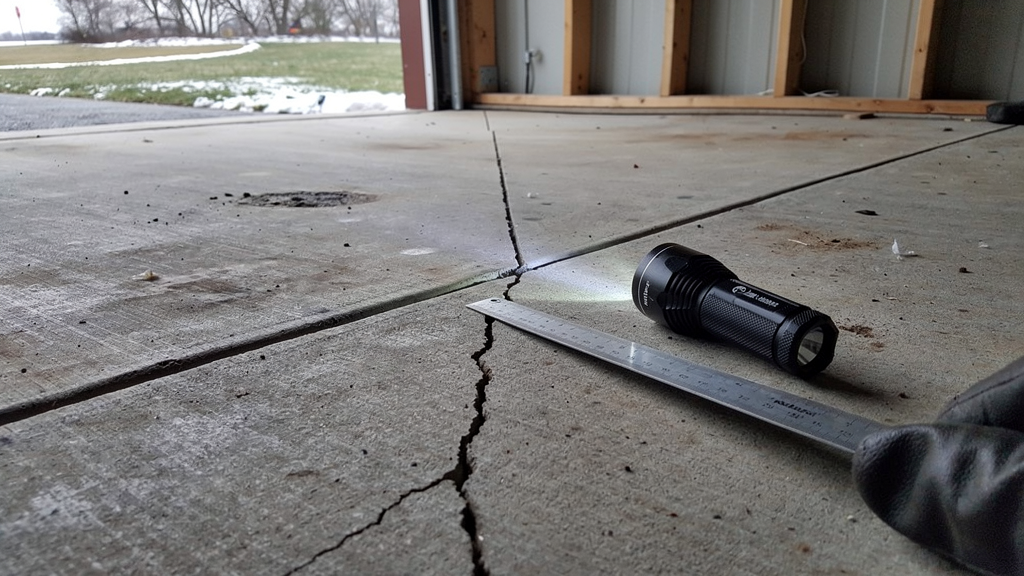
Not every crack in a concrete slab means the slab has failed. Concrete shrinks as it dries, and planned control joints are intended to give some movement a predictable location. The more useful questions are whether the crack is moving, whether the edges are at different heights, whether water is getting through, and whether the crack matches a broader pattern of settlement or surface loss.
Start with five observations
- Width: Is it a fine hairline, a visible gap, or wide enough to collect dirt and water?
- Movement: Does the crack change seasonally, or does the slab rock when stepped on?
- Elevation: Are the two sides at the same height, or is there a trip edge?
- Location: Is it in a control joint, near an edge, at a corner, or through the middle of a panel?
- Moisture: Does water, salt, soil, or dampness appear along the crack?
A simple triage chart
| Crack pattern | Usually means | Next step |
|---|---|---|
| Fine, stable hairline | Shrinkage or surface movement | Photograph, monitor, and seal if appropriate |
| Crack follows a control joint | Planned movement location | Check whether edges remain stable and sealed |
| Wide or widening crack | Active movement or stress | Get an assessment before patching |
| Crack with height difference | Settlement or base movement | Address the trip hazard and review concrete mudjacking for a settled slab when the panel is otherwise sound |
| Crack with spalling or exposed steel | Moisture, salt, or deeper deterioration | Evaluate repair depth and possible section replacement |
When cracks deserve prompt attention
Call sooner when a crack is widening, a panel rocks, edges are rising or dropping, water enters a garage or basement, or the slab supports a structure or equipment. A slab that is part of a foundation or structural system should be evaluated in the context of the building plans and local requirements.
What not to assume
A crack is not automatically proof of bad workmanship, and a patch is not automatically a permanent fix. The same visible line can come from different causes. A rigid filler may look neat for a while but fail if the two sides keep moving. Conversely, a small stable crack may only need monitoring and routine maintenance.
What to photograph
Take a full-area photo, a mid-range photo that shows nearby joints and edges, and a close-up with a ruler for scale. Note the date, recent weather, water, salt use, vehicle or equipment loads, and whether the crack has changed. That information makes the first conversation much more useful.
For a garage, shed, or general slab project, see concrete slabs in Milwaukee. For a driveway or patio, compare the focused service pages or call 414-219-1661.
Need a second opinion on the concrete?
Call 414-219-1661 or send the details through the quote form below.